

CAIO Connect Podcast with Bharat Prabhakaran & Host Sanjay Puri: Reinventing Higher Education with AI at the UC

CAIO Connect Podcast
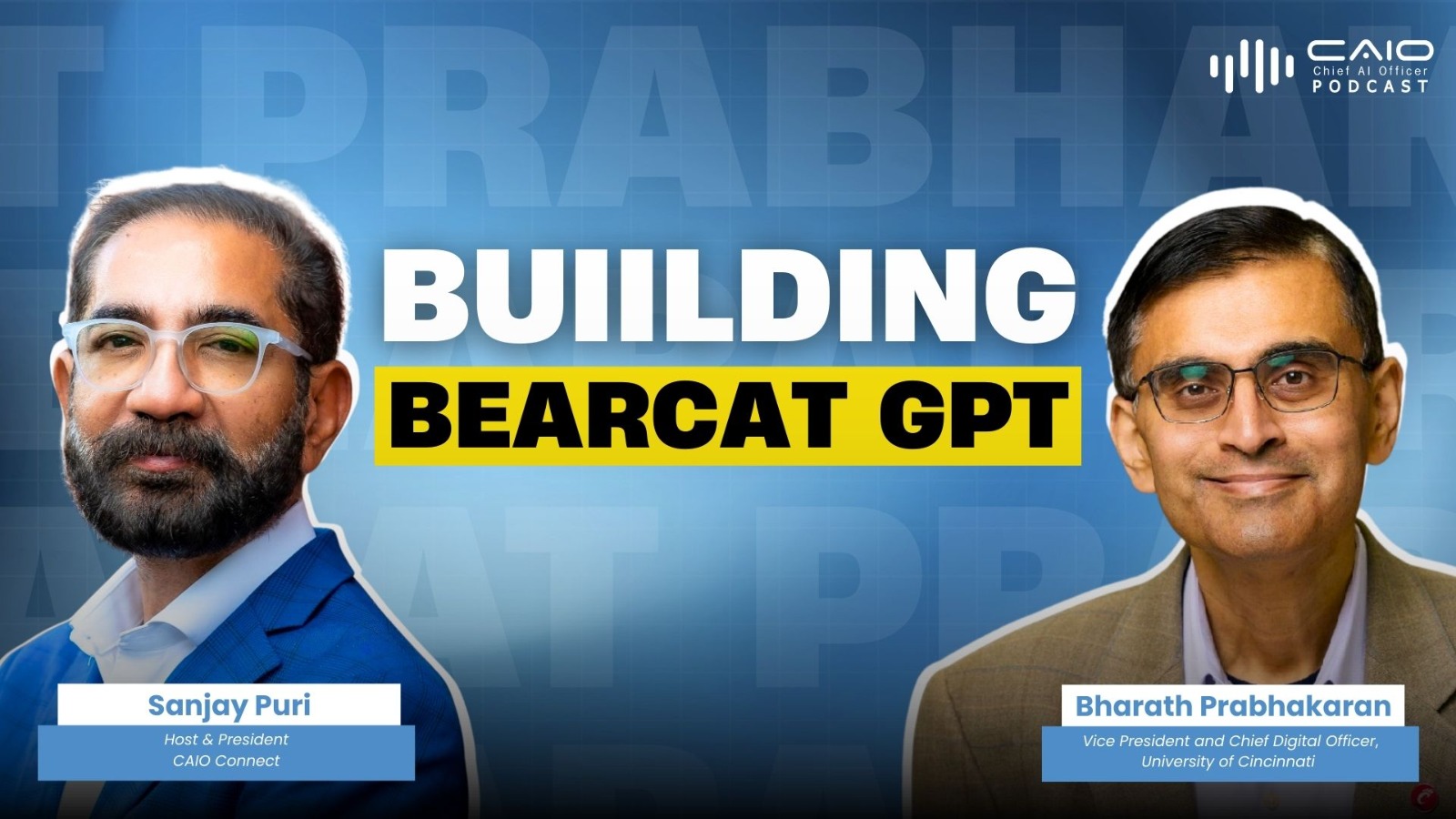
Bharat Prabhakaran, Vice President and Chief Digital Officer, University of Cincinnati with Sanjay Puri, Founder & Chairman, Knowledge Networks
On the CAIO Connect Podcast, Bharat Prabhakaran shares how UC is using AI to boost student success, governance, and future-ready learning.
In this conversation on the podcast, Bharat Prabhakaran shared how enterprise-grade AI thinking is being adapted to a mission-driven, governance-heavy academic environment — and why student success, not profit, is the north star.
From Corporate Tech to Campus Leadership
Bharat Prabhakaran’s journey, as discussed with CAIO Connect President Sanjay Puri on the CAIO Connect Podcast, is defined by calculated risks and continuous learning.
After arriving in the U.S. as a graduate student, he chose corporate technology over academia, navigating the dot-com era and spending 18 years at Oracle in multiple roles. Instead of job-hopping, he rotated internally, building depth and breadth.
But mid-career, purpose began to matter more than scale. That pivot — from Oracle to finance and eventually to higher education — was about impact. The lesson? Career acceleration isn’t about speed. It’s about flexibility, networks, and the courage to realign when your values shift.
Unlearning Corporate in Higher Ed
During the discussion, Bharat Prabhakaran candidly described the culture shock of moving from enterprise tech to academia.
In corporate settings, KPIs revolve around profit and market share. At the University of Cincinnati, the metrics are retention, student performance, and graduation rates. Governance is consensus-driven, not top-down. Relationships and trust matter more than hierarchy.
The technical skills transfer. The mindset must evolve.
Bearcat GPT: Building AI with Guardrails
A major highlight of the conversation with Sanjay Puri on the CAIO Connect Podcast was UC’s creation of its own Azure OpenAI instance — Bearcat GPT.
Why build internally? Data privacy, intellectual property protection, and research sensitivity.
Rather than a campus-wide rollout, UC piloted the system with roughly 1,000 users. A call for use cases generated nearly 100 ideas, narrowed to 14 through a structured rubric. Four governance committees — Teaching & Learning, Responsible AI, Policy & Guidelines, and Operations & Enablement — oversee adoption.
The message is clear: AI in institutions requires governance, enablement, and grassroots buy-in — not just deployment.
Designing AI That Teaches — Not Cheats
One of the most compelling initiatives discussed on the podcast was UC’s AI tutoring tools, including Bearcat Study Pal.
Instead of simply giving answers, the AI uses a Socratic design — asking guiding questions to strengthen understanding. The long-term vision? Personalization tied to Canvas LMS data, adapting to each student’s learning history.
Bharat Prabhakaran acknowledged a hard truth: AI tutoring research is mixed. Dependency is a real risk. Intentional design, not just technical capability, determines success.
Measuring ROI Without Profit
On the CAIO Connect Podcast, Bharat Prabhakaran framed AI ROI in two buckets: academic outcomes and operational efficiency.
Academic ROI means better retention and fewer withdrawals. Operational ROI includes automation wins, such as invoice processing improvements — familiar enterprise use cases adapted to campus realities.
The key insight he shared with Sanjay Puri: speak your stakeholder’s language. Faculty care about student outcomes. Finance leaders care about efficiency.
Agentic AI and the Data Challenge
Agentic AI is coming to higher education — but data readiness is the bottleneck.
At the University of Cincinnati, initiatives like Bearcat Insights (a lakehouse architecture combining AWS, Snowflake, and Informatica) aim to unify siloed data. Only then can intelligent agents meaningfully support enrollment workflows, advising, and back-office operations.
The timeline? One to two years — if data governance matures.
People, Process, Technology — In That Order
Bharat Prabhakaran closed his conversation with Sanjay Puri on the CAIO Connect Podcast with a timeless reminder: technology is the easiest part.
Changing mindsets is harder.
The future of AI in higher education won’t be determined by platforms alone. It will be shaped by leaders who connect stakeholders, communicate clearly, and align innovation with institutional purpose.
In an era of AI acceleration and enrollment uncertainty, universities that thrive will be those that remember: people first, process second, and technology third.
Upasana Das
Knowledge Networks
email us here
Visit us on social media:
LinkedIn
Instagram
Facebook
YouTube
X
Legal Disclaimer:
EIN Presswire provides this news content "as is" without warranty of any kind. We do not accept any responsibility or liability for the accuracy, content, images, videos, licenses, completeness, legality, or reliability of the information contained in this article. If you have any complaints or copyright issues related to this article, kindly contact the author above.
